
NewsDetails
High-Pressure Diaphragm Filter Press: Working Principle, Cake Moisture and ROI Guide
author:grh time:2026-10-05 10:33:42 Click:156
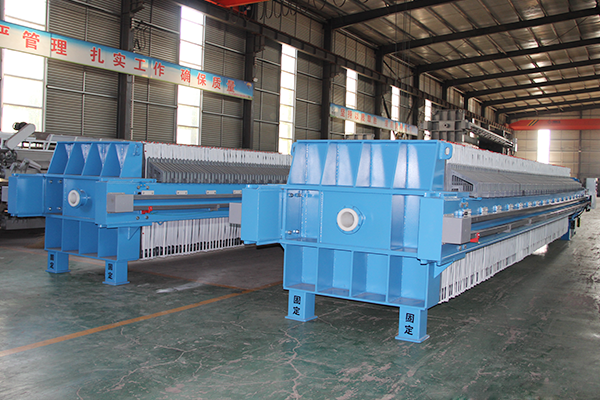
high-pressure diaphragm filter press has become the default choice for plants that must hit a strict cake moisture target without paying for a dryer. This guide explains the membrane squeezing cycle, the specifications that actually matter, and how to justify the upgrade on paper.
Why Membrane Squeezing Changed Industrial Dewatering
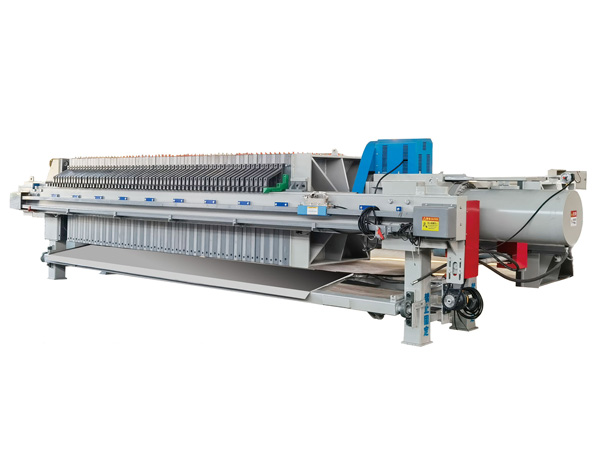
A conventional chamber filter press stops working when the feed pump can no longer overcome cake resistance. The result is a cake that is still saturated in its core. A diaphragm filter press adds a second, mechanical stage: after the chamber is filled, water or compressed air is injected behind an elastomer membrane welded to the plate, inflating it to 1.6–3.0 MPa and physically squeezing the remaining liquid out of the cake.
The practical consequences are measurable rather than marketing claims:
Cake moisture is typically 8–18 percentage points lower than with a comparable chamber press on the same slurry.
Cycle time drops by roughly 20–35%, because the filtration stage can be ended earlier and finished by squeezing.
Wash liquor consumption falls, since the membrane compresses the cake into a denser, more uniformly permeable bed before washing starts.
Cake release improves — the membrane flexes and breaks the cake–cloth bond, which matters for sticky tailings and oily sludge.
Anatomy of a High-Pressure Diaphragm Filter Press
Understanding the parts makes supplier quotations comparable. Every machine in this class contains the same functional groups:
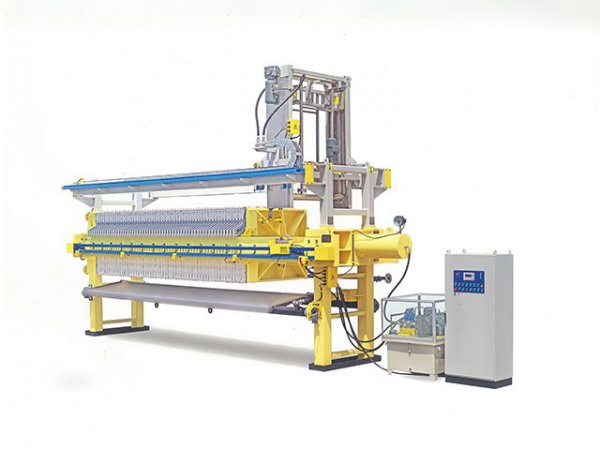
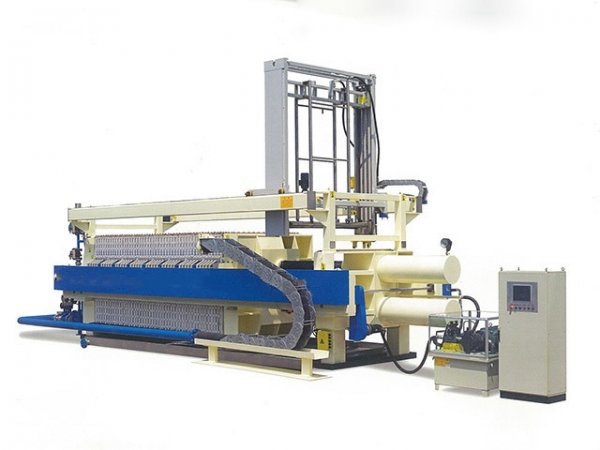
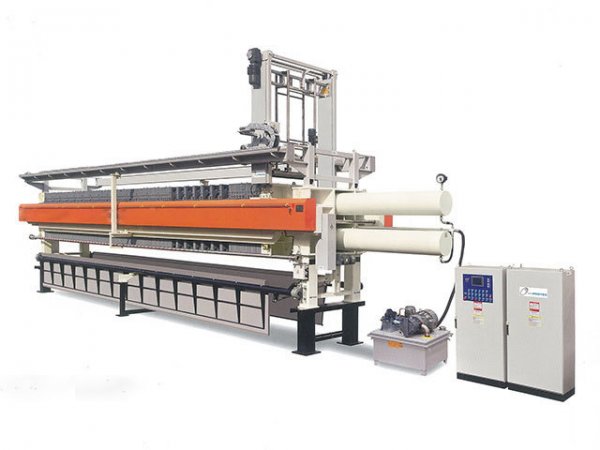
Filter plate stack — alternating chamber plates and diaphragm plates, typically polypropylene (PP), available in 1000, 1250, 1500 and 2000 formats.
Filtrate manifold — corner-feed, centre-feed or upper-feed ports that set the maximum feed velocity and therefore the wear rate of the cloth.
Hydraulic closing unit — holds the stack against filtration pressure with an oil cylinder and a pressure-holding circuit.
Squeeze circuit — high-pressure water pump or air compressor, plus the safety interlock that prevents squeezing before the chamber is full.
Control system — from manual valve banks to a program-controlled automatic filter press with PLC, automatic plate shifting and cloth washing.
Key Specifications to Compare Before You Buy
| Item | What to ask the manufacturer | Typical range |
|---|---|---|
| Filtration area | Set by plate size × plate count | 20–500 m² |
| Plate size | PP diaphragm plate, matched to your cake thickness | 630–2500 mm |
| Feed pressure | Should match your pump curve, not the brochure maximum | 0.6–1.6 MPa |
| Squeeze pressure | Verified against plate burst test certificate | 1.6–3.0 MPa |
| Cake thickness | Thicker cake = fewer cycles, higher moisture | 30–45 mm |
| Automation | Manual / semi-auto / program-controlled | PLC + auto shift |
A real configuration example from our own production line: the XMYZ250/1250-U runs 93 + 2 pieces of 1250 × 1250 × 65 mm plates for a 250 m² filtration area, while the XMYZ100/1250-U uses 37 + 2 plates for 100 m². Same plate, same spare parts inventory — only the frame and the plate count change. That modularity is what keeps the operating cost of a filter press China supply contract low over ten years.
Selecting the Right Plate Material
Polypropylene remains the engineering default because it is non-toxic, odourless, and resists acids, alkalis and salts across the pH range most plants actually operate in. It is also roughly one third the weight of cast iron, which reduces crane load and makes plate changing a two-person job.
Move away from PP only when the duty demands it: sustained temperature above the PP envelope, aggressive organic solvents, or a product-contact requirement that specifies stainless steel. In those cases a plate-and-frame design with a different membrane elastomer (EPDM, NBR or TPE) is specified instead.
Where Diaphragm Presses Deliver the Highest Return
Coal washing — fine coal and tailings dewatering, where every point of moisture is a penalty on calorific value.
Mine tailings — non-ferrous flotation concentrates and tailings paste for dry stacking.
Municipal and industrial wastewater — sludge volume reduction before landfill or incineration.
Food and starch — potato starch, rice flour and alcohol feed separation where wash efficiency drives product yield.
Fine chemicals — catalyst recovery and product crystal separation with a solvent-compatible membrane.
How to Calculate the Payback
Build the business case on four numbers rather than on the purchase price:
Disposal cost avoided. If 10 t/d of dry solids leaves at 75% moisture instead of 60%, you are paying to truck and landfill roughly twice the water weight.
Cycle time saved. Fewer cycles per day = lower pump kWh and lower labour per tonne of cake.
Wash water saved. Important when the filtrate has to be re-treated.
Downstream value. Drier coal or concentrate sells at a better price; drier sludge burns with less auxiliary fuel.
For most sludge dewatering equipment retrofits, the incremental cost of a diaphragm press versus a chamber press is recovered within 8–20 months on disposal savings alone.
FAQS
How much lower is cake moisture with a diaphragm filter press?
On municipal sludge, a chamber press typically discharges at 70–80% moisture while a diaphragm press with a 1.6 MPa squeeze reaches 55–65%. On mineral concentrates the gap is smaller, usually 3–6 points, but still decisive for transport cost.
Can an existing chamber filter press be upgraded to a diaphragm press?
Partially. If the frame, hydraulic unit and plate size are compatible, replacing a portion of the chamber plates with diaphragm plates is possible. It requires re-verifying frame thrust, because squeezing adds load that the original frame was never rated for.
What squeeze medium should I use, water or air?
Water gives a smoother, more controllable pressure ramp and is preferred for large plates above 1500 mm. Air is cheaper to install and is common on smaller or mobile units, but compressibility makes pressure holding less stable.
What routine maintenance does the membrane need?
Inspect the membrane surface for blisters and weld-line cracking at every cloth change, keep squeeze pressure below the nameplate value, and never squeeze an empty or partially filled chamber. With those three rules, membrane life normally exceeds several years of continuous duty.
Conclusion
The high-pressure diaphragm filter press is not simply a bigger chamber press — it is a two-stage machine that converts hydraulic energy into a drier, more transportable cake. Specify it by filtration area, squeeze pressure and plate material rather than by model name, and ask the manufacturer for a cake-moisture guarantee based on a sample of your own slurry.
Hebei Shuangcheng Environmental Protection Equipment Co., Ltd. manufactures diaphragm chamber filter presses and matching PP filter plates from 630 × 630 mm to 2500 × 2500 mm on automated production lines, with customisation available for plate size, feed method and control level. Send your slurry data for a free selection study.
Ready to Upgrade Your Solid-Liquid Separation Line?
Hebei Shuangcheng Environmental Protection Equipment Co., Ltd. designs and manufactures high-pressure diaphragm filter presses, chamber filter presses, plate and frame filter presses and PP filter plates from 630 × 630 mm up to 2500 × 2500 mm. Share your slurry type, daily throughput and target cake moisture with our engineering team and receive a selection proposal built around your process.
 Recommended Products
 Contact us
—— Contact:Manager
—— Tel:+86 16632826789
—— Email:sales@hbscfilterpress.com
—— Url:https://www.hbscfilterpress.com
—— Address:West Zone of Economic Development Zone, Fucheng County, Hengshui City, Hebei Province