
NewsDetails
Polypropylene Filter Plate Specification Guide: 1000, 1250, 1500 and 2000 Types Explained
author:grh time:2026-10-11 12:02:52 Click:139
The plate is the part that actually fails, wears and costs you money. This guide covers how to read a polypropylene filter plate specification, how the 1000 / 1250 / 1500 / 2000 types differ, and which three checks decide whether a plate lasts two years or eight.
Why Polypropylene Is the Default Plate Material
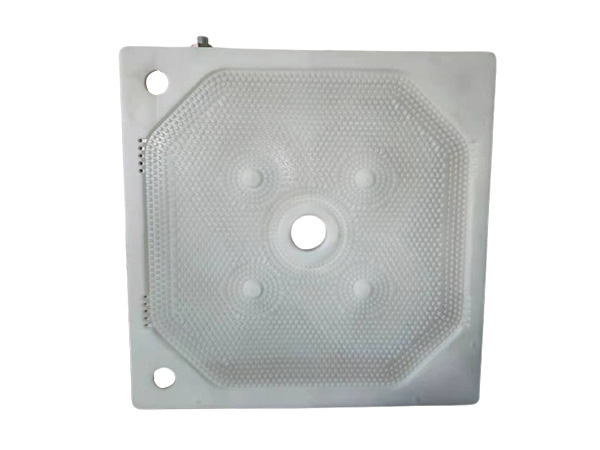
Polypropylene (PP) is non-toxic, odourless, and chemically inert across the pH range encountered in most industrial slurries. It resists acids, alkalis and salt solutions, has a low density that keeps plates light enough for two-person handling, and can be moulded into complex internal drainage structures at a fraction of the cost of machined metal. For a filter press manufacturer in ChinaPP is also the material that can be produced repeatably at volume on automated lines.
PP is not universal. Sustained high temperature, chlorinated or aromatic solvents, and certain product-contact approvals push you towards cast iron, stainless steel or a specialty polymer. For the great majority of mineral, wastewater and food duties, PP remains correct.
Plate Types and What They Do
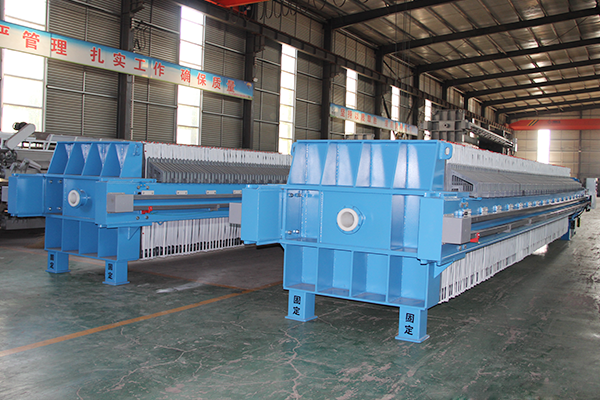
Chamber (recessed) plate — the standard. Two adjacent plates form one chamber; the cloth is a sleeve passed through the centre hole.
Diaphragm / membrane chamber plate — a chamber plate with a welded elastomer membrane that inflates for the squeeze stage. This is the plate behind every high-pressure diaphragm filter press.
Plate-and-frame plate — a flat filtering surface used with a separate hollow frame.
Corner-feed plate — feed enters at a corner port instead of the centre, which is the preferred geometry for fast-filtering slurries and for reducing cloth wear at the feed eye.
Size and Pressure: Reading the Numbers
| Plate type | Outline size | Typical thickness | Notes |
|---|---|---|---|
| 630 series | 630 × 630 mm | 50–60 mm | Pilot and laboratory duty |
| 1000 type | 1000 × 1000 mm | 60–65 mm | Compact production units |
| 1250 type | 1250 × 1250 mm | 65–70 mm | Global workhorse; filtration pressure up to 3.0 MPa |
| 1500 type | 1500 × 1500 mm | 70–80 mm | High throughput, fewer plates per frame |
| 2000 type | 2000 × 2000 mm | 80–90 mm | Large municipal and mining installations |
Matched machine configurations in the 1250 family illustrate how plate count scales capacity: XMYZ100/1250-U uses 37 + 2 plates, XMYZ150/1250-U uses 55 + 2, XMYZ180/1250-U uses 68 + 2, XMYZ200/1250-U uses 75 + 2, and XMYZ250/1250-U uses 93 + 2 — all with the identical 1250 × 1250 × 65 plate.
Feed Method: The Specification Most Buyers Ignore
The feed port geometry controls both how fast the chamber fills and how quickly the cloth wears out.
Centre feed — slurry enters at the plate centre. Simple and robust; the feed eye is the highest-wear area of the cloth.
Upper feed — entry from the top port, useful where solids settle quickly and you want gravity to assist distribution.
corner feed filter plate — entry at a corner, which reduces direct impingement on the cloth and gives more even chamber filling on fast-filtering slurries.
Three Inspections That Determine Plate Life
Moulding quality at the sealing face. The sealing land must be flat and free of sink marks. A plate that leaks at the land will cut the cloth and spray filtrate for its whole life.
Internal drainage structure. Consistent pips or grooves keep the cloth off the plate surface. Too few drainage points and the filtration rate collapses; too many and the plate loses strength.
Membrane weld integrity on diaphragm plates. Inspect the weld line for voids and check that the squeeze port is not restricted. A membrane failure is almost always a weld or over-pressure failure, not a material failure.
Standardising Spare Parts Across a Fleet
If you operate more than one press, standardise on a single plate size and a single feed method. Doing so lets you hold one spare-plate size and one cloth part number, which typically cuts spare inventory value by 30–50% and, more importantly, avoids the wrong-part delay that keeps a press down for weeks.
FAQS
What is the service life of a polypropylene filter plate?
With correct operating pressure, no mechanical impact and a compatible slurry temperature, PP plates routinely run for several years. Abrasive slurries and impact damage from cake-chiselling are the two factors that shorten life, not chemical attack.
Can I mix diaphragm plates into an existing chamber plate stack?
Yes, and it is the standard way to build a squeeze press, but the plates must be alternated in the correct pattern and the frame and hydraulic system must be rated for the additional squeeze force. Always confirm with the plate manufacturer before mixing.
How do I know whether I need corner feed?
If your slurry filters quickly and the chamber fills unevenly — recognisable by a cake that is thick at the feed end and thin at the far end — corner or distributed feed will even out chamber filling and reduce cloth wear at the feed eye.
Are custom plate sizes available?
Yes. Plates from 630 × 630 mm up to 2500 × 2500 mm can be produced, and non-standard outlines can be tooled for retrofit projects where an obsolete press must keep running.
Conclusion
Specify a polypropylene filter plate by four variables — outline size, type (chamber, diaphragm, plate-frame, corner feed), feed method and pressure rating — and you will get comparable quotations instead of marketing brochures. Then protect the investment with correct handling and one standardised spare size.
Hebei Shuangcheng operates automated PP filter plate production covering 630–2500 mm in chamber, diaphragm and corner-feed designs, supplying both complete presses and replacement plates for existing machines.
Ready to Upgrade Your Solid-Liquid Separation Line?
Hebei Shuangcheng Environmental Protection Equipment Co., Ltd. designs and manufactures high-pressure diaphragm filter presses, chamber filter presses, plate and frame filter presses and PP filter plates from 630 × 630 mm up to 2500 × 2500 mm. Share your slurry type, daily throughput and target cake moisture with our engineering team and receive a selection proposal built around your process.
 Recommended Products
 Contact us
—— Contact:Manager
—— Tel:+86 16632826789
—— Email:sales@hbscfilterpress.com
—— Url:https://www.hbscfilterpress.com
—— Address:West Zone of Economic Development Zone, Fucheng County, Hengshui City, Hebei Province