
NewsDetails
Filter Press for Coal Washing and Mine Tailings: Dewatering Targets, Configurations and Results
author:grh time:2026-10-15 13:10:48 Click:118
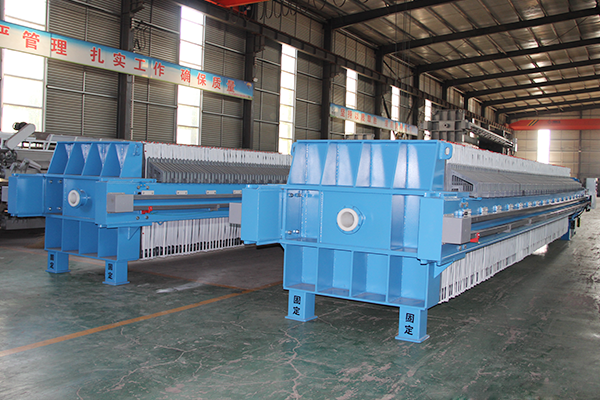
Coal preparation plants and mine sites have one shared objective: move water out of fine solids as cheaply as possible. This guide sets out what a filter press for coal washing can realistically achieve, and which configuration survives abrasive tailings duty.
Where a Filter Press Sits in the Flowsheets
In a coal washing plant the press normally treats two streams: fine coal (typically below 0.5 mm) recovered by flotation or spirals, and tailings from the thickener underflow. In hard-rock and non-ferrous operations it handles flotation concentrate and final tailings ahead of dry stacking or backfill.
The press sits after thickening and ahead of disposal or sale. Every percentage point of moisture removed at this stage is a point you do not pay to transport, and in the case of fine coal, a point of calorific value you do not lose.
Achievable Moisture: What the Numbers Really Are
| Stream | Chamber press | Diaphragm press (1.6 MPa squeeze) |
|---|---|---|
| Fine clean coal (−0.5 mm) | 22–28% | 16–22% |
| Coal tailings / refuse | 26–32% | 20–26% |
| Base-metal flotation concentrate | 14–20% | 10–15% |
| Hard-rock tailings | 18–25% | 14–20% |
These are typical plant ranges, not guarantees. Particle size distribution and clay content move the result more than any machine parameter — a tailings stream with high clay fines will always retain more water. Verify with a pilot plate test on your own sample.
Configuration That Survives Abrasive Duty
Mining slurry is abrasive, so the specification priorities are different from municipal sludge:
Chamber plate, PP, 1250 or 1500 type — monolithic moulding withstands repeated high-pressure cycles and is light enough for fast change-out.
diaphragm filter press mining configuration — the squeeze stage is what converts a 26% tailings cake into a stackable 20% cake.
Corner-feed or reinforced feed eye — the feed area is where abrasive wear starts on the cloth.
Automatic plate shifting — mining presses are large; manual shifting is neither safe nor fast enough.
Heavy-duty cloth — a tighter weave resists particle penetration at some cost to filtration rate; the trade is almost always worth it.
Dry Stacking and Tailings Management
Regulators increasingly push mines towards dry stacking because it reduces the stored water inventory and the consequence of dam failure. A filter press is the enabling technology: producing a cake at 15–20% moisture that can be trucked and compacted, in contrast to a slurry at 50–60% moisture that must be impounded.
Operating Practices That Protect Throughput
Keep feed solids consistent. A thickener underflow that swings from 25% to 45% solids produces uneven chamber filling and mechanical stress on plates.
Ramp feed pressure. Start at low pressure and increase as the cake builds; this extends cloth life dramatically on abrasive streams.
Wash the cloth on a fixed schedule. Do not wait for the filtration rate to collapse — by then the blinding is largely permanent.
Log cycle times. A cycle that slowly lengthens is the earliest and cheapest warning of cloth blinding or pump wear.
Hold a spare plate stack allowance. One cracked plate out of 93 stops the machine.
Water Recovery and Closed-Circuit Operation
In water-scarce regions, the value of a press is measured in recovered process water rather than in cake. A well-clarified filtrate can be returned directly to the plant circuit, cutting raw-water make-up and reducing the volume reporting to the tailings facility. Specify a clear-filtrate sight glass and, where practical, a filtrate diversion valve so that the first cloudy portion of each cycle is returned to the thickener instead of the clean tank.
FAQS
Can a filter press replace a tailings dam?
It can enable dry stacking, which greatly reduces the water stored behind a dam and the associated risk. Whether it can remove impoundment entirely depends on closure rules and on whether the dewatered cake meets geotechnical and leaching criteria in your jurisdiction.
What cake moisture is needed for trucking tailings?
Most operations target 15–20% moisture for truck transport and compaction. Below roughly 14% the cake starts to generate dust and may need conditioning; above 22% it tends to slump and lose bearing strength.
How often will filter cloth need changing on coal tailings?
Abrasive coal refuse typically consumes cloth faster than municipal sludge. Expect to plan on a scheduled replacement programme rather than reactive replacement, and keep a full spare set on site, because cloth change-out is the planned downtime you can least afford to improvise.
Is a diaphragm squeeze worth the extra cost for tailings?
For dry stacking, usually yes. The four to six moisture points gained by squeezing often decide whether the cake can be compacted at all, and the alternative — adding thermal drying — costs far more in both capital and energy.
Conclusion
For coal washing and mine tailings, the press is a moisture-management asset. Set the target moisture first from the disposal or product requirement, then select a diaphragm filter press mining configuration with automatic shifting and a cloth specification matched to the abrasiveness of your stream.
Hebei Shuangcheng supplies chamber and high-pressure diaphragm presses with PP plates up to 2500 mm, plus filter cloth and accessories, and supports selection with pilot testing on customer slurry samples.
Ready to Upgrade Your Solid-Liquid Separation Line?
Hebei Shuangcheng Environmental Protection Equipment Co., Ltd. designs and manufactures high-pressure diaphragm filter presses, chamber filter presses, plate and frame filter presses and PP filter plates from 630 × 630 mm up to 2500 × 2500 mm. Share your slurry type, daily throughput and target cake moisture with our engineering team and receive a selection proposal built around your process.
 Recommended Products
 Contact us
—— Contact:Manager
—— Tel:+86 16632826789
—— Email:sales@hbscfilterpress.com
—— Url:https://www.hbscfilterpress.com
—— Address:West Zone of Economic Development Zone, Fucheng County, Hengshui City, Hebei Province