
NewsDetails
Mobile Filter Press for River Dredging and Industrial Sludge: Skid-Mounted Dewatering Guide
author:grh time:2026-10-19 13:31:53 Click:190
Dredging projects and temporary industrial clean-ups have one thing in common: the slurry is where the work is, and it moves. A mobile filter press brings the dewatering plant to the slurry instead of hauling the slurry to the plant.
What Makes a Filter Press "Mobile"
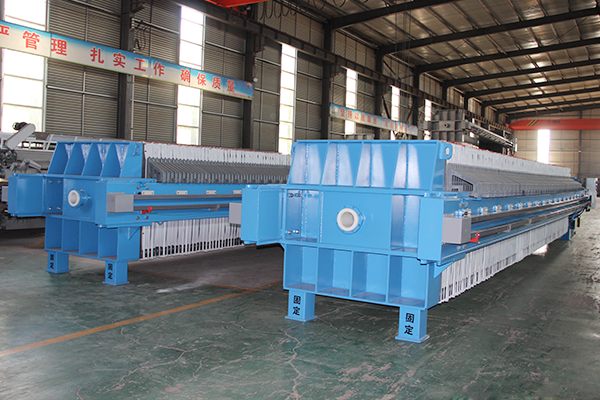
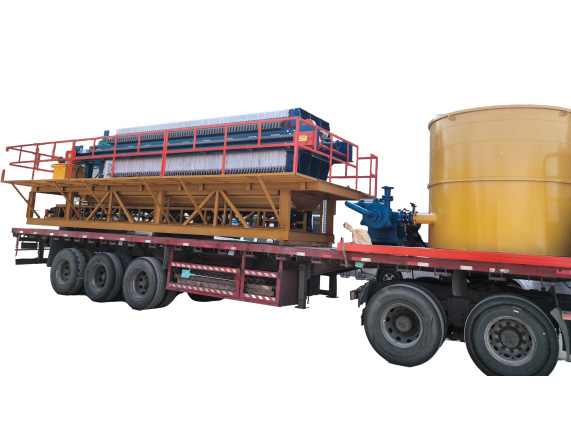
A mobile or skid-mounted filter press is a complete dewatering package — press, feed pump, conditioning and dosing skid, air compressor, control cabinet and sometimes the conveyor — mounted on a steel skid or inside a shipping container so that it can be lifted, trucked and commissioned within days.
Skid-mounted — open frame on a base, best for installation inside an existing building or under a shelter.
Containerised — enclosed in a 20 or 40 ft container, weatherproof and lockable, preferred for remote or unsecured sites.
Trailer-mounted — road-legal chassis for projects that relocate weekly.
River and Canal Dredging: The Driving Application
Dredged sediment is a difficult material: high water content, variable particle size, often contaminated, and produced in very large volumes in a short campaign. Dewatering on the bank solves three problems at once.
Volume reduction. Sediment dredged at 20–40% solids becomes a handleable cake, cutting truck movements by more than half.
Water return. Clear filtrate can be returned to the river, subject to the discharge permit — essential when there is nowhere to store dirty water.
Disposal classification. Drier cake usually qualifies for a cheaper disposal category than wet dredged material.
Sizing a Mobile Unit for a Campaign
Mobile units are specified against a campaign, not a continuous plant:
| Project scale | Typical configuration | Indicative throughput |
|---|---|---|
| Small canal / pond clean-out | Single 630–1000 press on one skid | 5–20 m³/h feed |
| Municipal river reach | 1250-type diaphragm press, containerised | 20–60 m³/h feed |
| Large dredging campaign | Two to four 1500/2000 presses in parallel | 80–200 m³/h feed |
Remember the transport constraint: the largest single item is the press frame. If site access is poor, two smaller presses that can each be lifted by an available crane beat one large press that cannot be delivered.
Utilities and Site Requirements
Power — feed pump plus hydraulics plus compressor; confirm whether a generator set is needed and size it for simultaneous starting loads.
Water — for polymer make-up and cloth washing.
Compressed air — for the squeeze stage and air blow-down; an oil-free compressor avoids contaminating the cake.
Ground bearing — a loaded press plus cake hopper is heavy; a compacted pad or spreader plates are usually required.
Drainage — filtrate routing and a bunded area for wash water, particularly on contaminated sediment sites.
Operating a Mobile Unit in the Field
Field conditions punish weak designs. Specify for them:
Control cabinet with adequate ingress protection and a dust-filtered vent.
Vibration-resistant wiring and secured piping — road transport loosens fittings.
Lifting points and fork pockets that match the equipment available on site.
On-board spares: one cloth set, hydraulic seals, and the solenoid valves that stop a cycle.
Clear operating documentation, because the operator is often a contractor who has never run this machine.
When a Mobile Unit Is Not the Right Answer
If the slurry is generated at a fixed point for more than about two years, a permanent installation is almost always cheaper per tonne. Mobile units trade capital efficiency for speed and flexibility. Choose them when the project is temporary, the site is remote, the slurry source moves, or when you need to prove the process before committing to a permanent plant.
FAQS
How quickly can a mobile filter press be commissioned on site?
A containerised unit that arrives pre-piped and pre-wired can typically be unloaded, levelled, connected to power and slurry, and started within one to three days, depending on site services and crane availability.
Can a mobile press handle contaminated dredged sediment?
Yes, provided the cake and filtrate are handled according to the site's classification. Enclosed units with drip trays and bundled drainage make containment easier, and an explosion-proof configuration is specified where volatile contaminants are present.
What cake dryness is realistic for dredged sediment?
Sandy sediment dewaters readily and can reach 30–40% dry solids with a chamber press. Fine, organic-rich silt behaves more like sludge and benefits from a diaphragm squeeze, typically landing in the 35–50% range with conditioning.
Is it cheaper to hire or to buy a mobile dewatering unit?
For a single short campaign, hiring is usually cheaper and shifts maintenance risk to the supplier. For repeated projects across several years, buying is cheaper per campaign and gives you the asset for emergency response work.
Conclusion
A mobile filter press converts a dredging or remediation project from a water-hauling exercise into a solids-handling exercise. Specify it against the campaign volume, the site's utilities and the transport limits of the access route, and insist on field-grade electrical and piping workmanship.
Hebei Shuangcheng designs skid-mounted and containerised filter press packages for river dredging and industrial clean-up, from 630 mm pilot units to 2000 mm production presses.
Ready to Upgrade Your Solid-Liquid Separation Line?
Hebei Shuangcheng Environmental Protection Equipment Co., Ltd. designs and manufactures high-pressure diaphragm filter presses, chamber filter presses, plate and frame filter presses and PP filter plates from 630 × 630 mm up to 2500 × 2500 mm. Share your slurry type, daily throughput and target cake moisture with our engineering team and receive a selection proposal built around your process.
 Recommended Products
 Contact us
—— Contact:Manager
—— Tel:+86 16632826789
—— Email:sales@hbscfilterpress.com
—— Url:https://www.hbscfilterpress.com
—— Address:West Zone of Economic Development Zone, Fucheng County, Hengshui City, Hebei Province