
NewsDetails
Program-Controlled Automatic Chamber Filter Press: Automation Features, Labour Savings and Payback
author:grh time:2026-10-09 12:00:32 Click:161
Automation is the single largest lever on filter press operating cost, because it removes the operator from the cycle. This article breaks down what a program-controlled automatic chamber filter press does, which features are worth paying for, and how to quantify the saving.
What "Program-Controlled" Actually Covers
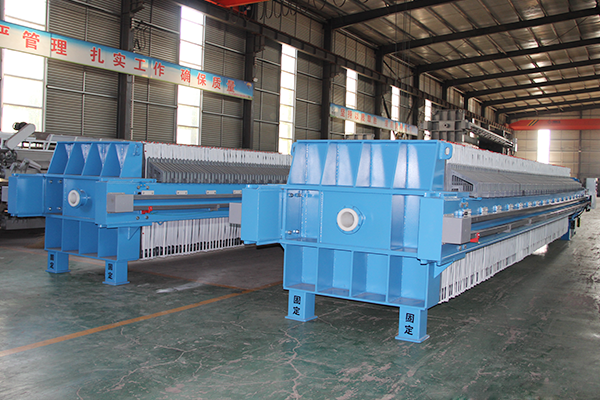
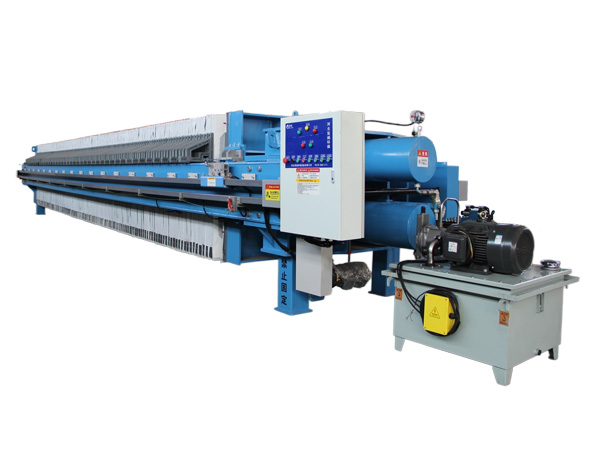
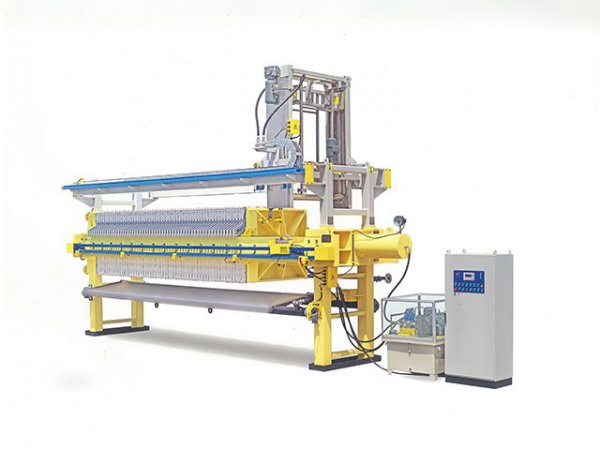
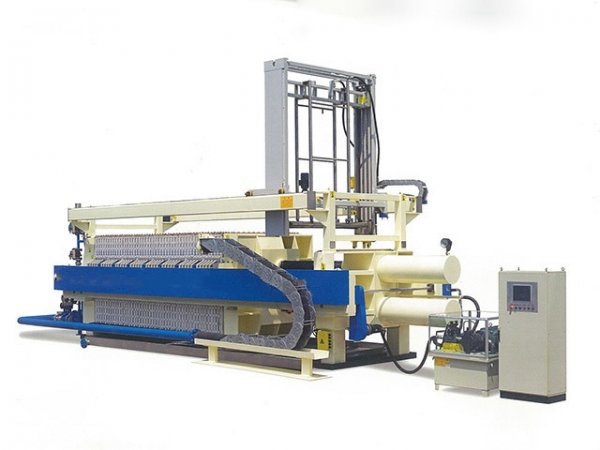
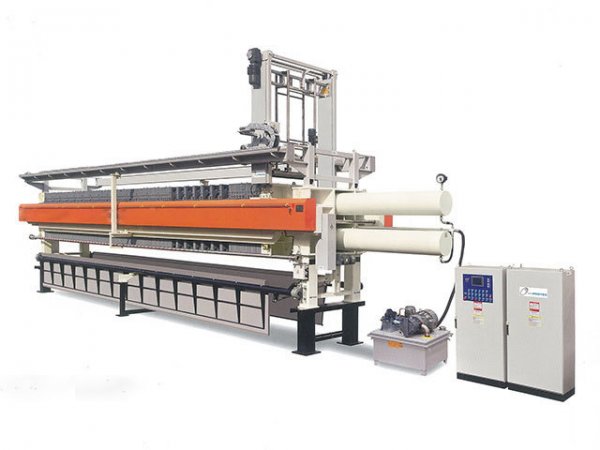
The term is used loosely in the market. In a genuine PLC filter press, the control cabinet sequences the entire cycle without operator intervention: closing and pressure holding, feed, optional cake washing, optional air blow-down, opening, plate shifting and cake discharge. The operator presses start and returns when the stack has emptied.
Automatic plate shifting — a shuttle or chain-driven carriage opens the plates one by one, so cake drops continuously instead of in one uncontrolled slide.
Automatic drip tray (flip-board) — closes during filtration to keep residual filtrate off the discharged cake, opens for discharge.
Automatic cloth washing — a travelling high-pressure header regenerates the cloth without removing it.
Pressure and position interlocks — the PLC will not open the stack until pressure is confirmed at zero.
Data logging — cycle count, feed pressure, cycle duration and alarm history for OEE reporting.
Labour: The Number That Justifies the Upgrade
Take a mid-size plant running a 200 m² press eight cycles per day. Manual operation consumes roughly 20 minutes of operator attention per cycle for plate shifting, cake knocking and visual cloth checks — about 2.7 hours per day, or more than one full shift per week.
| Mode | Operator time per cycle | Cycles/day | Daily labour |
|---|---|---|---|
| Manual | 20 min | 8 | 2.7 h |
| Semi-automatic | 9 min | 8 | 1.2 h |
| Program-controlled automatic | 2 min | 8 | 0.3 h |
At an operator cost of USD 6–10 per hour, the saving alone is USD 4,000–7,000 per year per machine — before counting the extra cycles that become possible because the machine no longer waits for a person.
Automation Options: What to Specify, What to Skip
Worth it almost always: automatic plate shifting, pressure interlocks, automatic pressure holding, and a drip tray where the cake is a saleable product.
Worth it for blinding slurries: automatic cloth washing. If your cloth blinds within a few weeks, in-place washing pays back fastest of any option.
Worth it for hazardous duty: explosion-proof motors and control cabinets, plus a self-locking frame — see our dedicated guide to explosion-proof filter press configurations.
Often unnecessary: remote cloud dashboards on a single-machine site. They add cost without changing cycle time. Add them only when several presses are supervised centrally.
Integration With the Rest of the Plant
An automatic press is only as fast as its weakest neighbour. Before ordering, confirm the interface with four items:
Feed pump — variable-speed drive so the PLC can ramp pressure instead of slamming the cloth at start-up.
Slurry tank level and agitator — to prevent feeding a settled, over-thick slurry that fills chambers unevenly.
Cake discharge handling — conveyor or hopper sized for the full batch, since an automatic press drops the whole cake in minutes.
Filtrate return — gravity or pumped, with a clear-water sight glass that the PLC can monitor.
Commissioning and Operator Training
Most automation complaints trace back to commissioning, not to hardware. Insist on: a full dry cycle before slurry is introduced; verification of every limit switch; a documented alarm list; and training for both operators and the maintenance electrician. A machine delivered with a generic PLC program and no alarm documentation will be run in manual within a month.
FAQS
How much does automatic plate shifting reduce cycle time?
Plate shifting itself is the visible saving, roughly 10–15 minutes per cycle on a large press. The larger gain is consistency: because discharge no longer depends on operator availability, most sites report 10–25% more cycles per week from the same machine.
Can an existing manual chamber press be retrofitted with automation?
Often yes. Adding a plate-shifting carriage, proximity switches and a control cabinet is feasible on most modern frames. What cannot be retrofitted cheaply is the frame rigidity required for higher automatic cycling, so verify the frame condition first.
Does automation reduce filter cloth life?
No, it usually extends it. Automatic cloth washing removes blinding particles before they become permanent, and consistent, PLC-controlled pressure ramps avoid the start-up pressure spikes that damage cloth in manual operation.
What spare parts should I stock for an automatic press?
Shift-carriage drive chains and sprockets, proximity or limit switches, hydraulic seals, solenoid valves and one spare cloth set. These are the items that stop the cycle; plates and membranes fail far more slowly and can be ordered with a normal lead time.
Conclusion
A program-controlled automatic chamber filter press converts a batch machine that depends on people into a repeatable production asset. Specify the automation that attacks your actual bottleneck — labour, cloth blinding or cycle consistency — and treat commissioning and training as part of the scope, not an afterthought.
Hebei Shuangcheng supplies chamber and diaphragm presses from manual hydraulic units to fully program-controlled lines with automatic plate shifting, flip-board drip trays and cloth washing, all built around in-house PP filter plates.
Ready to Upgrade Your Solid-Liquid Separation Line?
Hebei Shuangcheng Environmental Protection Equipment Co., Ltd. designs and manufactures high-pressure diaphragm filter presses, chamber filter presses, plate and frame filter presses and PP filter plates from 630 × 630 mm up to 2500 × 2500 mm. Share your slurry type, daily throughput and target cake moisture with our engineering team and receive a selection proposal built around your process.
 Recommended Products
 Contact us
—— Contact:Manager
—— Tel:+86 16632826789
—— Email:sales@hbscfilterpress.com
—— Url:https://www.hbscfilterpress.com
—— Address:West Zone of Economic Development Zone, Fucheng County, Hengshui City, Hebei Province