
NewsDetails
Explosion-Proof and Self-Locking Membrane Filter Presses for Chemical and Hazardous Duty
author:grh time:2026-10-21 13:53:27 Click:92
When the filtrate is flammable, every motor, switch and spark on the machine becomes a risk assessment item. This guide explains how an explosion-proof filter press is engineered, and where the self-locking membrane frame fits.
Start From the Area Classification, Not the Machine
Before any equipment is specified, the site must classify the hazardous area — zone or division, gas group and temperature class. That classification, not the supplier's brochure, dictates which protection concept applies to each component. A press installed in a zone where flammable vapour may be present during normal operation needs a higher level of protection than one where vapour is only possible under fault conditions.
Motors — flameproof or increased-safety enclosures matched to the zone and gas group.
Control cabinet — purged and pressurised, or flameproof, with certified cable glands.
Instrumentation — intrinsically safe circuits for level, pressure and position sensors.
Static control — bonding and earthing of plates, frame and piping, and anti-static filter cloth where the solvent is non-conductive.
What the Self-Locking Frame Does
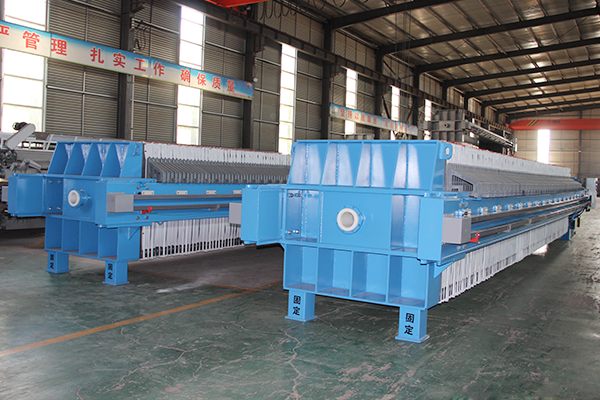
A self-locking membrane filter press adds a mechanical locking device to the plate stack or frame. Once the press is closed, the lock carries the filtration and squeeze thrust mechanically rather than relying on continuous hydraulic pressure. The benefits are specific:
Safety — the stack cannot open if hydraulic pressure is lost, which matters where a sudden opening would release solvent vapour and cake into the workspace.
Energy — the hydraulic pump does not have to hold pressure for the whole filtration cycle.
Consistency — mechanical locking holds the stack at a fixed dimension, giving repeatable chamber volume and cake thickness.
Materials: Solvent Compatibility Is the Hard Part
Polypropylene plates handle aqueous acid and alkali well but can be attacked by chlorinated and aromatic solvents at elevated temperature. For solvent duty, evaluate in this order:
Plate polymer — confirm chemical compatibility at the actual operating temperature, not at ambient, and include the cleaning solvent in the assessment.
Membrane elastomer — EPDM, NBR or TPE depending on the solvent; a membrane that swells loses its squeeze geometry and fails at the weld.
Filter cloth — PP, polyester or aramid, selected for both chemical resistance and the required particle retention.
Seals and gaskets — the most commonly overlooked item and the most common source of a solvent leak.
Closed Systems and Vapour Control
For volatile filtrates, the press is normally part of a closed system:
Closed filtrate manifold piped to a sealed receiving tank rather than an open launder.
Vapour extraction at the cake discharge point, routed to a scrubber or carbon bed.
Nitrogen blanketing where the solvent is highly volatile or oxygen-sensitive.
Air blow-down using nitrogen rather than compressed air, which is a common upgrade on solvent presses.
Safety Interlocks That Should Never Be Optional
Pressure confirmation before opening. The PLC must verify zero chamber pressure before releasing the lock.
Light curtain or barrier at the plate stack, interlocked with the shifting mechanism.
Emergency stop at both ends of the machine, not just at the control cabinet.
Squeeze interlock preventing membrane inflation until the chamber is confirmed full.
Temperature monitoring on the hydraulic power unit and, for solvent duty, on the filtrate line.
Documentation matters as much as hardware: request the hazardous-area certificates for every powered component, the earthing plan, and a written start-up and shutdown procedure that operators can follow without improvisation.
FAQS
Do I need a full explosion-proof press or only an explosion-proof motor?
It depends on the zone classification. In many installations only the motors, control cabinet and instrumentation within the classified area need certified protection, while the frame and plates are passive. Have the classification assessed first; over-specifying adds cost, under-specifying is a safety failure.
What is the difference between a standard and a self-locking membrane press?
The self-locking version adds a mechanical device that holds the stack closed independently of hydraulic pressure. It improves safety on loss of hydraulic pressure, reduces energy consumption during long cycles, and gives more repeatable chamber volume.
Can a filter press filter flammable solvents safely?
Yes, when the machine is built for the classification: certified motors and controls, bonded and earthed conductors, anti-static cloth, closed filtrate handling and nitrogen rather than air for blow-down and, where applicable, squeezing.
How often should the safety interlocks be tested?
Functionally test pressure-before-opening, emergency stops and light curtains at every planned maintenance stop, and record the result. Waiting for an incident to discover a bypassed interlock is the most common failure pattern in hazardous-area equipment.
Conclusion
Chemical and hazardous duty is an engineering exercise in classification, material compatibility and interlocks. Specify the explosion-proof filter press components from the area classification, choose plate and membrane materials against the actual solvent and temperature, and treat the safety interlocks as part of the process, not as paperwork.
Hebei Shuangcheng manufactures high-pressure membrane self-locking filter presses and explosion-proof configurations, and can supply material compatibility guidance and hazardous-area documentation for project review.
Ready to Upgrade Your Solid-Liquid Separation Line?
Hebei Shuangcheng Environmental Protection Equipment Co., Ltd. designs and manufactures high-pressure diaphragm filter presses, chamber filter presses, plate and frame filter presses and PP filter plates from 630 × 630 mm up to 2500 × 2500 mm. Share your slurry type, daily throughput and target cake moisture with our engineering team and receive a selection proposal built around your process.
 Recommended Products
 Contact us
—— Contact:Manager
—— Tel:+86 16632826789
—— Email:sales@hbscfilterpress.com
—— Url:https://www.hbscfilterpress.com
—— Address:West Zone of Economic Development Zone, Fucheng County, Hengshui City, Hebei Province